AI Search
Google AI Overviews Are Reshaping Commercial Search: What Every SEO Professional Needs to Know in 2026
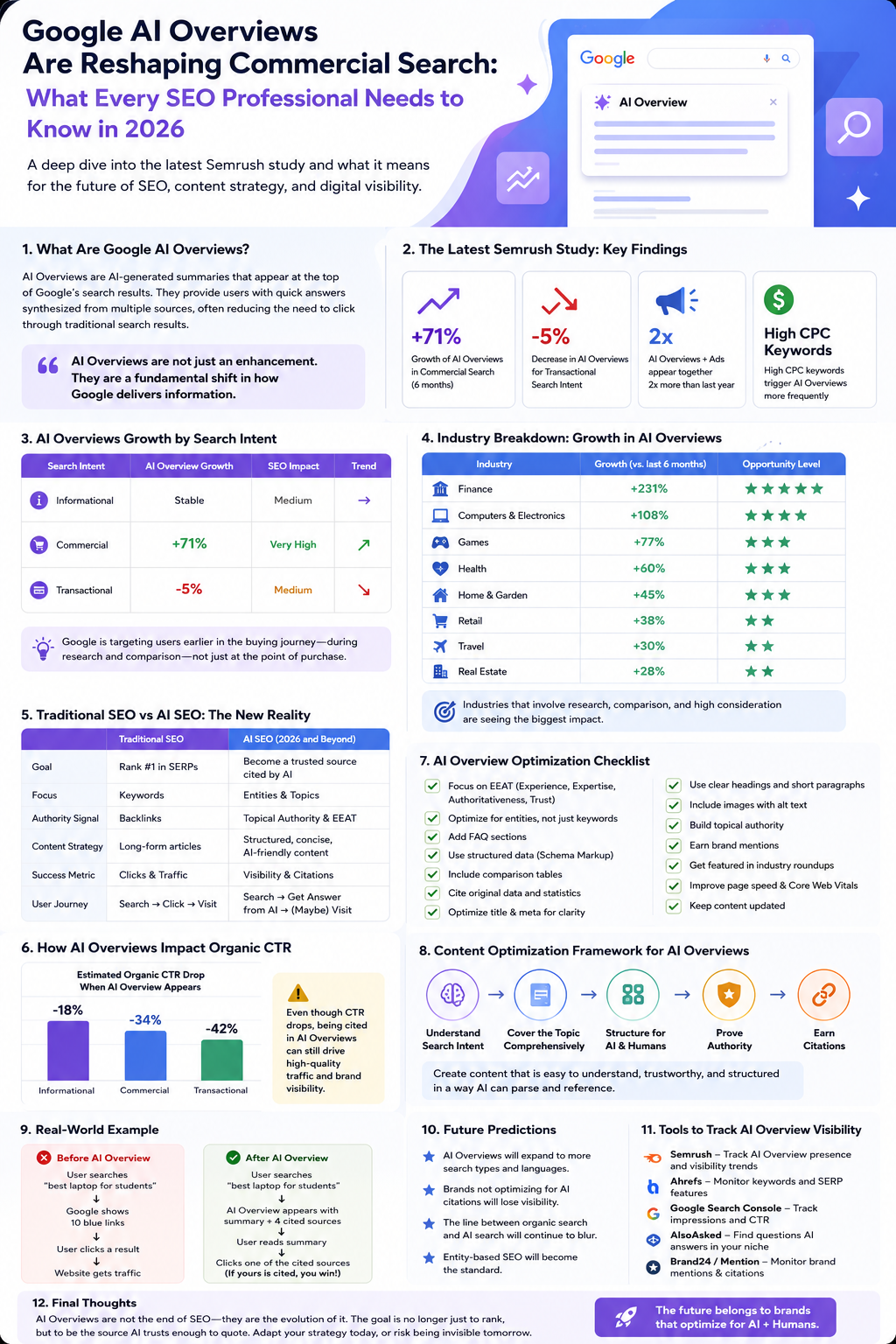
A deep dive into the latest Semrush study on Google AI Overviews — what changed in commercial search, industry-by-industry growth, CTR impact, and the exact playbook to get your brand cited by AI in 2026.
What you need to know about introduction?
Google AI Overviews are no longer an experiment. In the last 6 months they have quietly moved from an informational novelty at the top of the SERP to a core commercial surface — one that reshapes how buyers discover products, compare options, and decide who to trust before they even click.
The latest Semrush study, combined with what I see week to week working with brands across KSA, the UAE, the US and Egypt, tells a clear story: commercial intent queries are now the fastest-growing category inside AI Overviews, and the SEO teams that adapt first will own the citations that everyone else copies.
This guide breaks the study down, adds first-hand analysis, and gives you the exact framework to earn a place inside AI Overviews in 2026 — not just rank for keywords.
What Are Google AI Overviews?
AI Overviews are AI-generated summaries that sit at the very top of Google's results. They synthesise multiple sources into a single, opinionated answer and cite a handful of websites as evidence. For the user, one glance often replaces reading three pages of blue links.
That shift is fundamental. Google is no longer just ranking documents — it is composing an answer and choosing which brands to attribute it to. Being cited inside an AI Overview is quickly becoming more valuable than ranking #4 or #5 organically, because visibility, brand recall and click quality all compound on a single trusted mention.
What you need to know about the Latest Semrush Study: Key Findings?
Semrush tracked AI Overview appearances across millions of SERPs over 6 months. Four numbers matter most for SEO strategy in 2026:
+71% growth of AI Overviews on commercial-intent queries. This is where budgets, revenue and competition live.
-5% on transactional queries. Google is deliberately holding back on 'buy now' style SERPs to protect merchant clicks.
2x more overlap between AI Overviews and paid ads — they now co-exist on the same SERP twice as often as a year ago.
High-CPC keywords trigger AI Overviews far more frequently, meaning the most commercially valuable terms are also the ones Google is most eager to summarise.
What you need to know about aI Overviews Growth by Search Intent?
Not every query type moved the same way. The clearest way to see the shift is by intent:
Informational — stable growth, medium SEO impact. Overviews were already common here.
Commercial — +71% growth, very high SEO impact. This is the battleground.
Transactional — -5%, medium impact. Google still sends the click for pure conversion queries.
The message is simple: Google is targeting users earlier in the buying journey — the research and comparison phase — not the final click. If your content only shows up at the bottom of the funnel, you are being cut out of the conversation where trust is actually formed.
What you need to know about industry Breakdown?
Growth of AI Overviews is wildly uneven across verticals. The Semrush data (last 6 months) shows the widest swings in exactly the industries where consideration cycles are longest:
Finance +231% — five-star opportunity. Comparison, definitions and 'is X safe?' queries dominate.
Computers & Electronics +108% — four-star opportunity. Spec-heavy content is being summarised aggressively.
Games +77% — three stars. Recommendations and 'best X for Y' queries lead.
Health +60% — three stars. Trust and EEAT are the deciding factor.
Home & Garden +45%, Retail +38%, Travel +30%, Real Estate +28% — all showing meaningful expansion.
If your niche involves research, comparison and high-consideration decisions, assume AI Overviews will be the default entry point to your category within 12 months.
What you need to know about commercial Search Has Changed Forever?
The old commercial SEO play — rank a long comparison page, capture the click, convert on-site — is being compressed. Increasingly, the answer, the comparison and the recommendation happen inside the SERP itself.
That does not kill commercial SEO. It changes what winning looks like. Being one of 3–5 sources cited in an AI Overview for a term like 'best CRM for small business' now delivers brand equity, downstream branded search and higher-intent clicks — even if the raw click-through rate on that impression is lower.
The winners in 2026 will be brands treated by Google's models as the reference source for their category, not the ones with the most pages.
How AI Overviews Impact Organic CTR?
The trade-off is real. Estimated organic CTR when an AI Overview appears drops sharply: -18% on informational queries, -34% on commercial and -42% on transactional. Those are big numbers and worth planning around.
But the same data holds a critical nuance: being cited inside the AI Overview can still drive high-quality traffic and — more importantly — brand visibility that compounds. The click you 'lose' to the summary is often replaced by a warmer branded visit later. Optimise for citation, not just clicks.
Why Traditional SEO Isn't Enough Anymore?
Traditional SEO optimised documents. AI SEO optimises entities, topics and trust. Here is the shift in plain terms:
Goal: from 'rank #1 in SERPs' to 'become a trusted source cited by AI'.
Focus: from keywords to entities and topics.
Authority signal: from backlinks alone to topical authority + EEAT.
Content strategy: from long-form padded articles to structured, concise, AI-friendly content.
Success metric: from clicks and traffic to visibility and citations.
User journey: from 'search → click → visit' to 'search → get answer from AI → maybe visit'.
If your reporting still stops at rank tracking, you are measuring the old game while Google is playing the new one.
What you need to know about strategies to Rank Inside AI Overviews?
Getting cited by an AI Overview is not luck. Across the sites I have inside overviews today, a consistent pattern shows up:
1. Answer the specific question in the first 2–3 sentences of the relevant section. AI models extract short, self-contained answers.
2. Structure content with clear H2/H3 questions, short paragraphs and comparison tables. Structure is what makes you quotable.
3. Cover the topic comprehensively — definitions, comparisons, pros/cons, use cases, FAQs — on one page or one tight cluster.
4. Prove authority: named authors, credentials, first-hand data, original research and citations to primary sources.
5. Earn brand mentions across independent sites. AI models weight co-citation heavily as an authority signal.
What you need to know about technical SEO Checklist for AI Overviews?
Technical foundations still matter — perhaps more, because AI parsers are less forgiving than crawlers. Ship these before you touch content:
Clean, semantic HTML with a single H1 and logical heading hierarchy.
FAQ, Article and Product schema where relevant, validated and rendered server-side.
Fast Core Web Vitals — LCP under 2.5s, INP under 200ms, CLS under 0.1.
Server-rendered content: never rely on client-only JS to expose your answer.
Descriptive alt text on every meaningful image.
Internal links that connect entity pages to supporting content.
Sitemap freshness and IndexNow pings on publish and updates.
What you need to know about content Optimization Framework for AI Overviews?
A five-step framework I now use on every commercial page:
1. Understand search intent — what is the user actually deciding?
2. Cover the topic comprehensively — anticipate the follow-up questions.
3. Structure for AI and humans — short answers, tables, lists, clear sections.
4. Prove authority — author, sources, first-hand data, EEAT signals.
5. Earn citations — outreach, PR, digital mentions and being genuinely useful.
Create content that is easy to understand, trustworthy, and structured in a way AI can parse and quote. That is the whole game.
What you need to know about real-World Example: Before vs After AI Overview?
Before AI Overviews, a user searching 'best laptop for students' saw ten blue links, clicked one, and the website earned the visit.
After AI Overviews, the same user sees an AI-generated summary with 4 cited sources at the top. They read the summary. If your brand is one of the four cited, you win a click, a brand impression and downstream trust. If not, you are invisible on the query you used to rank for.
That single change reframes SEO strategy: the goal is to be one of the cited four.
What you need to know about future Predictions?
Four predictions I would stake my roadmap on for the next 18 months:
AI Overviews will expand to more search types, languages and Arabic-first markets — including KSA and UAE where I already see rollouts accelerating.
Brands that do not optimise for AI citations will lose visibility faster than they lost rankings in the mobile-first era.
The line between organic search and AI search will keep blurring — teams will need one strategy, not two.
Entity-based SEO will become the default. Keywords still matter, but entities are how models think.
What you need to know about tools to Track AI Overview Visibility?
You cannot improve what you cannot see. The stack I currently use to monitor AI Overview presence and citations:
Semrush — tracks AI Overview presence and visibility trends per keyword.
Ahrefs — monitors keyword movement and SERP feature ownership.
Google Search Console — the ground truth for impressions and CTR shifts.
AlsoAsked — surfaces the follow-up questions AI models are pulling from.
Brand24 or Mention — track brand mentions and citations across the open web.
What you need to know about final Thoughts?
AI Overviews are not the end of SEO. They are the evolution of it. The goal is no longer just to rank — it is to be the source AI trusts enough to quote.
Adapt your strategy today — structure, entities, EEAT, citations — or risk being invisible tomorrow. The future belongs to brands that optimise for AI + humans, in that order.
If you want a second pair of eyes on your commercial pages and AI Overview readiness, get in touch — I review a small number of sites every month across KSA, UAE, USA and Egypt.